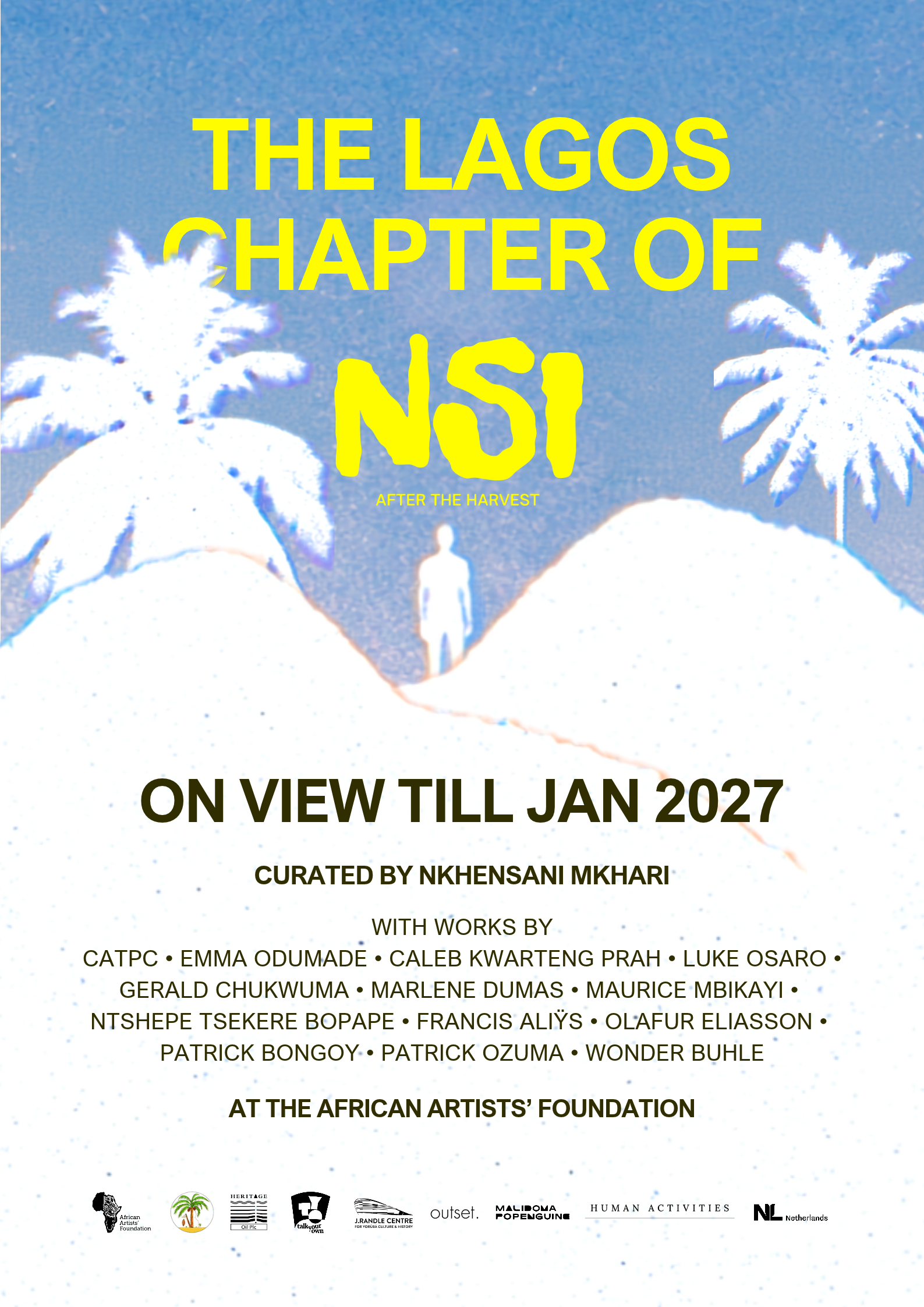
Nsi: After the Harvest, a research-led exhibition examining the enduring consequences of extraction and the possibilities of restitution through contemporary art, remains on view at African Artists’ Foundation (AAF) in Lagos until January 2027.
Curated by Nkhensani Mkhari, the Lagos chapter brings together works by the Cercle d’Art des Travailleurs de Plantation Congolaise (CATPC), Emma Odumade, Caleb Kwarteng Prah, Luke Osaro, Gerald Chukwuma, Marlene Dumas, Maurice Mbikayi, Ntshepe Tsekere Bopape, Francis Alÿs, Olafur Eliasson, Patrick Bongoy, Patrick Ozuma and Wonder Buhle.
Developed in collaboration with CATPC and Human Activities, the exhibition considers the plantation as a historical structure whose economic, ecological and social consequences continue to shape the present. It asks what remains after land has been cultivated, resources extracted and labour expended, and how artistic practice might participate in processes of recovery and repair.
The exhibition takes its name from Nsi, a Kikongo word encompassing land, earth, country and the realm of the ancestors. Within this conceptual framework, land is understood as a site of memory, belonging and intergenerational relationships, rather than solely as territory or an economic resource. After the Harvest directs attention towards the conditions that follow extraction, including environmental damage, displacement, accumulated waste and the unequal distribution of wealth.
Central to the exhibition is the practice of CATPC, a collective of plantation workers and artists based in Lusanga, Democratic Republic of the Congo. Through the production and circulation of sculptures in the international art market, the collective generates resources to repurchase former plantation land and support ecological regeneration. Its work offers a practical model for understanding restitution as an ongoing process of reclaiming land and redirecting value.
The Lagos presentation places this practice in conversation with artists working across different materials, histories and geographies. Together, their works examine how extraction operates through landscapes, economies, technologies and cultural institutions, while considering the ways artists respond to its lasting consequences.
Organised around four interconnected curatorial registers, Sediment, Signal, Residue and Repair, the exhibition approaches these questions from different perspectives. Sediment considers the histories embedded in land, bodies and collective memory. Signal explores the capacity of artistic practice to communicate alternative accounts of these histories. Residue addresses the material and ecological consequences that persist after extraction. Repair considers restitution, reclamation and the possibility of rebuilding relationships between people, land and cultural value.
As the Lagos chapter continues into January 2027, Nsi: After the Harvest offers audiences an opportunity to engage with these questions through the distinct practices of its participating artists. The exhibition forms part of AAF’s continuing engagement with restitution, artistic research and the relationship between contemporary art and the historical conditions that shape African societies.
Nsi: After the Harvest is on view at African Artists’ Foundation, 3B Isiola Oyekan Close, off Adeleke Adedoyin Street, Victoria Island, Lagos, through January 2027.